Forensic Medical Bill Audits: An Invaluable Resource

Behind every complex medical bill is a personal, data-driven story. Unfortunately, that story is often riddled with errors that cost patients, and governments, thousands of dollars in invalid debt secondary to poor practices, fraud, waste, and abuse.
In the modern healthcare landscape, a medical bill is not just a list of services—it is a sophisticated compilation of thousands of standardized “codes” that represent the diagnoses, treatment, mitigation, cure, and prevention of medical conditions and disease processes. When a patient receives an itemized billing statement they are viewing the final coded output of a high-volume data entry system where error is a statistical certainty.
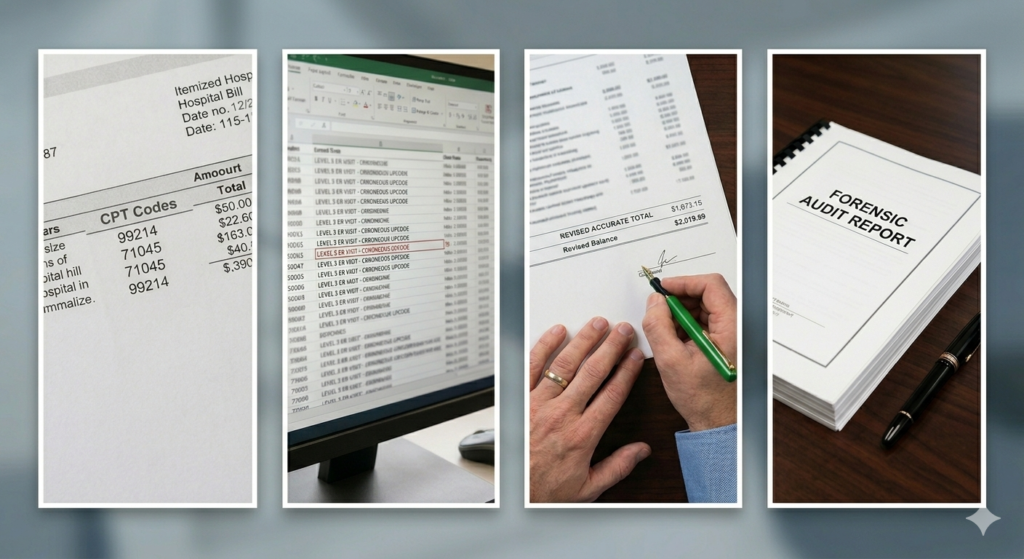
A forensic medical bill audit is the structural interrogation of a formal demand for payment. It examines the internal logic and regulatory compliance of the codes presented on an itemized bill and its payer-associated Explanation of Benefits (EOB) and its CMS 1450/UB-04 statements. Because a medical bill is the definitive financial representation of a clinical healthcare encounter, it must be architecturally sound to be legally enforcable. For example, certain codes must always occur together while others can never occur together. Some codes require a modifier when used repeatedly while others do not. A single code can be appropriately billed on one day but be inappropriate on a different day. There are currently over 173,000 HIPAA mandated individual codes representing medical diagnosis, treatment, supplies, drugs, and billing department revenues. Additionally, there are over 700 individual code modifiers that must be correctly applied to existing codes for a bill to be accurate – this is why the statistical chances of any given healthcare encounter being billed accurately is low.
Without a forensic audit, it is impossible for a patient to determine if their medical bill is accurate – the patient could be paying for any number of services that are erroneous or completely fradulent.
Why You Need a Forensic Medical Bill Audit
When faced with a significant medical bill it is completely normal to wonder where the charges came from and why the bill is so large. Upon inquiry, most patients are directed toward billing entity “Financial Assistance” or “Debt Settlement” departments. However, these bill reduction methods do not address the fundamental legitimacy of the charges themselves. Understanding this distinction is the difference between 1) a reduced bill and 2) an accurate bill that is now ready for reduction.
Path 1: Charity Care (The Request for Provider Mercy)
Charity care is a tiered, discretionary program administered by healthcare organizations (typically nonprofit hospitals). To qualify, one must undergo a “financial physical,” disclosing income, tax returns, bank statements, and assets. Even then, many hospitals/clinics deny these charity care applications for patient’s who meet the criteria who are also insured.
- The Risk: When requesting consideration for charity care a patient is doing nothing more than asking the hospital/clinic for a financial favor based on their income level and insurance status. If denied, the full (often erroneous) balance remains.
Path 2: Billing Resolution Advocacy Companies or Private Patient Advocates (The Art of Professional Haggling)
These individuals and organizations can be helpful, but you should know how they work. Most traditional medical bill resolution companies, as well as private patient advocates, treat medical bills like a starting price in a financial negotiation process that has little to do with overall bill accuracy. These organizations and individuals typically attempt to “argue the bill down” with the healthcare provider regardless of internal error. Further, they operate on contractual basis involving hourly rates or contingency plans often charging 30% to 40% of any reduction they achieve. One could ask what patient qualifying for a $15,000 bill reduction, based on billing error, has $5,000 in-hand to cover the cost of the auditor? Unless the bill has been paid in full the patient is not going to be reimbursed by anyone meaning the cost of the advocate must be out-of-pocket. Further, and more importantly, why should a patient pay an amount equal to 1/3 of billing error for a 2/3 reduction that was not even their fault? Other resolution organizations, such as nonprofits promoting free billing reductions, rely on individuals being able to qualify for tiered charity care – not everyone does. In fact, many healthcare organizations will reduce a bill by 10-20%, for anyone who asks, just for settling the balance immediately. The overwealming reality is that billing reduction agencies and private patient advocates may lower a total bill, but they aren’t doing anything a consumer can’t necessarily do themselves and they generally never investigate the erroneous coding data within the bill itself.
- The Risk: A billing resolution organization or private patient advocate may negotiate a medical bill reduction, but the patient is likely still paying for services they never actually received if a line-item forensic bill audit isn’t completed.
Path 3: Forensic Medical Bill Audit (The Gold Standard)
Our firm deviates from the above entirely. We deconstruct the bill and examine the integrity of the data itself against federally mandated standards. We are not a direct patient advocacy company, we do not negotiate on behalf of individuals, and we do not ask for financial amnesty or charity care for clients – individuals may qualify for these after the establishment of an accurate bill. We conduct a high-level, line-item, forensic review of a patient’s itemized medical bill and CMS-1450/UB04 to identify non-conforming coding errors that, if eliminated, can reduce a patients overall bill and ensure their medical expenses are tax compliant in terms of deductability.
- The Advantage: Patient empowerment and protection. Our forensic audit applies federally mandated billing standards to a client’s billing documents to determine which charges are allowable versus those which are not. Through uncovering non-conforming billing discrepancies, our clients gain the leverage required to have unsubstantiated charges removed from their medical bill. When leveraging our forensic billing report, our clients aren’t asking hospitals or clinics for a financial favor or a reduction based on socioeconomic status; they are demanding an accurate bill first and foremost.
How a Forensic Audit Reduces Your Medical Bill
1. Eliminates “ghost charges.” Hospitals and clinics often bill patients for supplies, medications, or bedside services that were ordered but never actually delivered or used. We identify these “phantom” costs by analyzing the internal logic of itemized statement to ensure they only pay for care they received. These ghost charges could even come in th eform of micro-fraud; a scenario where a billing entity places one or two small charges on a bill hoping they will go unnoticed and paid. Across hundreds of bills this micro-fraud can total millions of dollars.
2. Corrects tactical “upcoding.” Upcoding occurs when a hospital or clinic bills for a more expensive, complex level of service than actually provided (e.g., billing a routine ER visit for the flu as a Level 5 trauma). Artificial intelligence assisted upcoding is on the rise among hospitals and is used to increse revenue. Upcoding is considered medical fraud by the United States Government Department of Justice. Our audit identifies these fradulent codes and flags them for removal.
3. Identifies illegal “unbundling.” Many medical procedures are required by law to be billed as a “bundled” package with one price. Hospitals and clinics frequently “unbundle” these services, billing for each component separately to increase revenue. Unbundling is considered medical fraud by the United States Government Department of Justice. We catch these billing inconsistencies and flag them for removal.
4. Detects hidden duplicate billing. In a high, hospital or clinic, it is common for the same medication or lab test to be entered into the system twice. Because these bills are dozens of pages long, duplicates often go unnoticed. If a medication or lab is required twice it must have a modifing code attached otherwise it is a duplicate charge without substantiation – these are often rejected by insurance payers and reflected to patients. Our forensic review identifies repeat charges for the same service for removal.
5. Provides negotiating leverage. By providing a professional report that cites specific billing and coding inaccuracies that do not harmonize with federally mandated coding standards or specific provider-payer negotiated contracts, we shift the power dynamic in favor of the client. Billing entities confronted with such innacuracies must either substantiate the charge with evidence from the medical record from the date and time of service or remove the charge altogether.
6. Validates your coinsurance costs. In some instances a patient’s “out-of-pocket” responsibility (e.g. coinsurance) is based on the total bill; this is the case with High Deductible Health Plans and patients being billed hospital chargemaster rates. If the bill is inflated by 30% due to errors, the patient’s cost-sharing component is also erroneously inflated.
7. Eliminates uncertainty: Instead of guessing if a bill is accurate, we provide a line-by-line breakdown of correct charges representing legitimate medical care as well as a list of charges that are error or potential fraud all based on federal standardized billing and coding mandates and insurance contracts.
Click here to view how the same bill for heart attack treatment shows correct vs. erroneous charges and may be reduced via completion of a forensic billing audit.